Showing posts with label Church Calendar. Show all posts

Tuesday, 14 August 2012

Επιτάφιος της Παναγίας

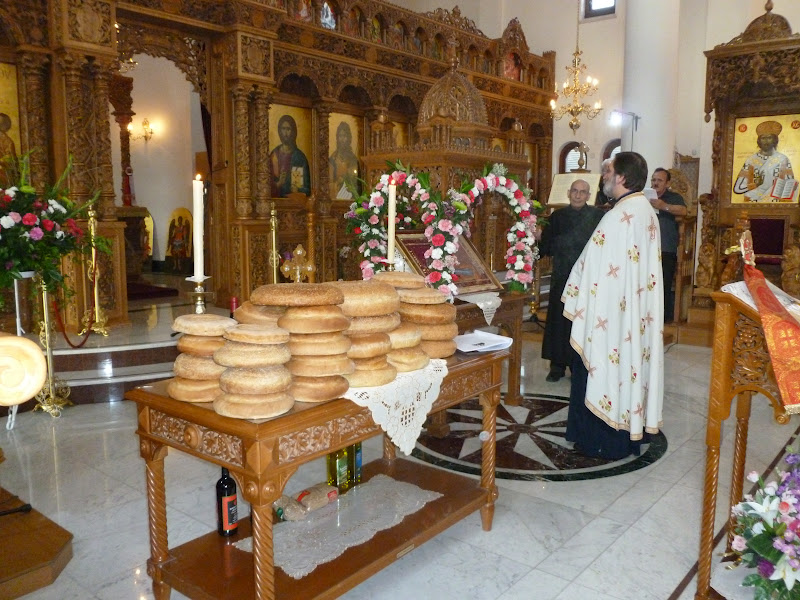
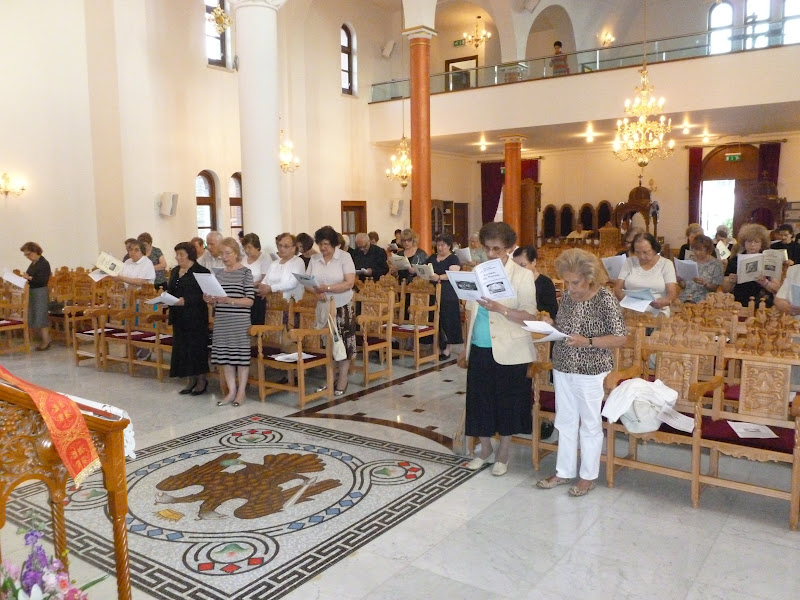
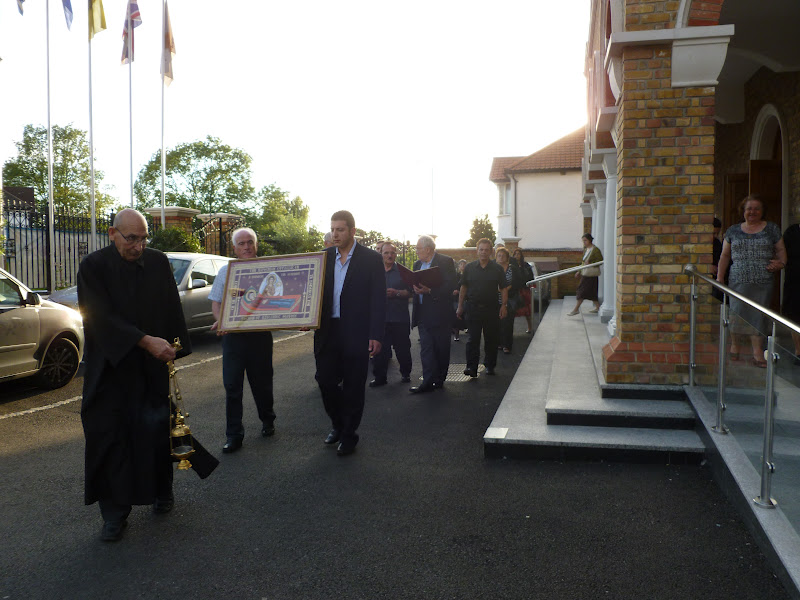
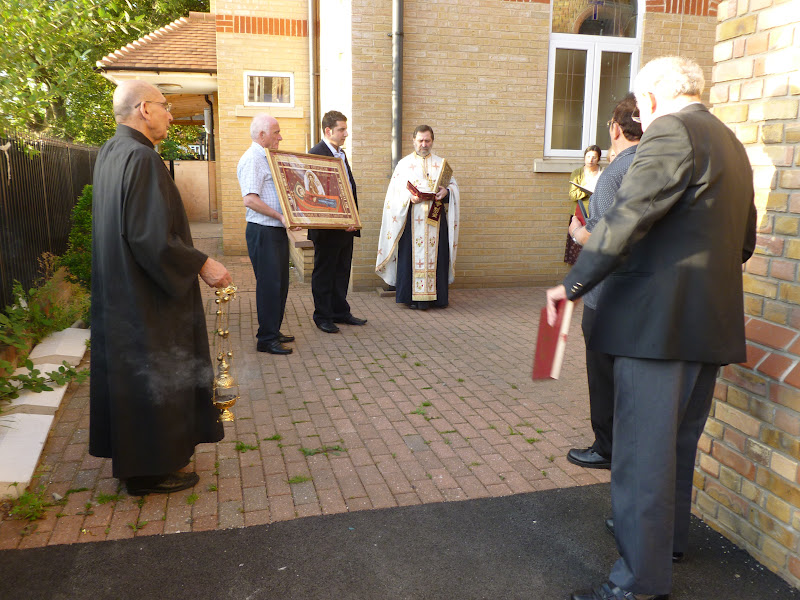
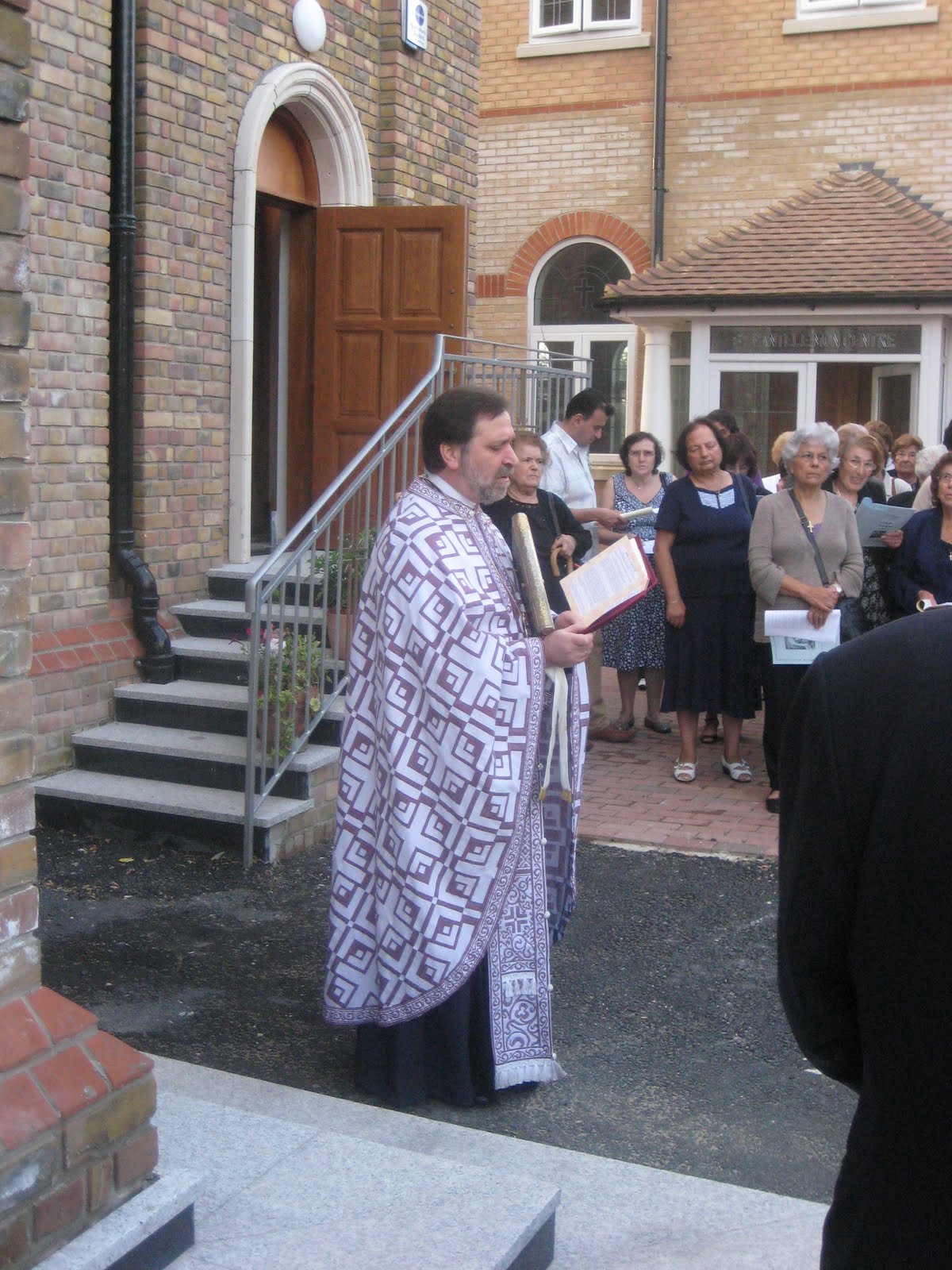
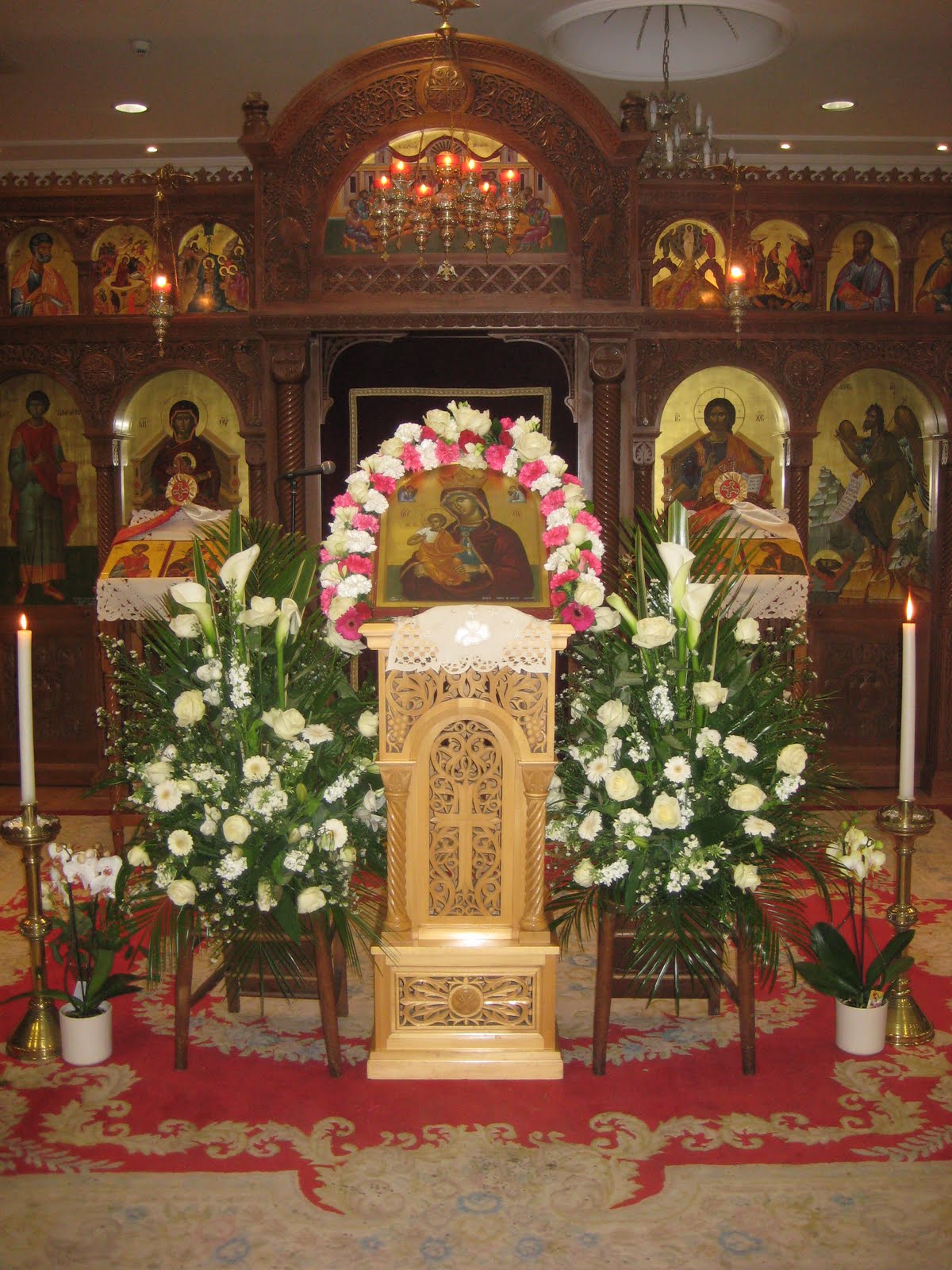
Απόψε τελέσαμε τον Μεγάλο Εσπερινό της Κοιμήσεως της Θεοτόκου και ψάλλαμε τα Εγκώμια της Παναγίας μας μπροστά από τον Επιτάφιο που είχαμε στολίσει ειδικά για τον σκοπό αυτό. Παρακάτω δημοσιεύουμε μερικές φωτογραφίες από την ωραία και κατανυκτική αυτή Ιερή Ακολουθία.
.
1.     Ετοιμασία Επιταφίου
.


2.     Ετοιμασία Αρτοκλασίας
.

3.     Ψάλλονται τα Εγκώμια
.


4.     Λιτανεύεται η ιερή εικόνα
.


5.     Πρώτη δέηση
.


6.     Δέηση στην είσοδο του Ναού
.


Wednesday, 14 September 2011

Feast of the Holy Cross

Saint Helen, the mother of Saint Constantine the Great, when she was already advanced in years, undertook, in her great piety, the hardships of a journey to Jerusalem in search of the cross, about the year 325.


A temple to Aphrodite had been raised up by the Emperor Hadrian upon Golgotha, to defile and cover with oblivion the place where the saving Passion had been suffered.


The venerable Helen had the statue of Aphrodite destroyed, and the earth removed, revealing the Tomb of our Lord, and three crosses. Of these, it was believed that one must be that of our Lord, the other two of the thieves crucified with Him; but Saint Helen was at a loss which one might be the Wood of our salvation.


At the inspiration of Saint Macarius, Archbishop of Jerusalem, a lady of Jerusalem, who was already at the point of death from a certain disease, was brought to touch the crosses, and as soon as she came near to the Cross of our Lord, she was made perfectly whole.


Consequently, the precious Cross was lifted on high by Archbishop Macarius of Jerusalem; as he stood on the ambo, and when the people beheld it, they cried out, "Lord have mercy." This event is commemorated today in our Holy Orthodox Church.


It should be noted that after its discovery, a portion of the venerable Cross was taken to Constantinople as a blessing. The rest was left in Jerusalem in the magnificent church built by Saint Helen, until the year 614. At that time, the Persians plundered Palestine and took the Cross to their own country.


Late, in the year 628, Emperor Heraclius set out on a military campaign, retrieved the Cross, and after bringing it to Constantinople, himself escorted it back to Jerusalem, where he restored it to its place.

Rest from labour. A Fast is observed today.

Saturday, 27 August 2011

St. Phanourios Day

Today our Holy Orthodox Church commemorates the memory of the Great Martyr Saint Phanourios. We had Matins and Divine Liturgy in the morning in our new Church. According to a popular custom people bake a special pie / cake in honour of St. Phanourios and bring it to the Church to be blessed. Many families had brought these cakes. Actually, after we had taken the picture there was many more cakes offered.


In regard to the Saint, little is known of the holy Martyr Phanourios. His holy icon was discovered in the year 1500 among the ruins of an ancient church on Rhodes, when the Moslems ruled there. Thus he is called "the Newly Revealed." The faithful pray to Saint Phanourius especially to help them recover things that have been lost, and because he has answered their prayers so often, the custom has arisen of baking a Phanouropita ("Phanourios-Cake") as a thanks-offering.

Sunday, 14 August 2011

Dormition of the Holy Theotokos

Our Holy Orthodox Church commemorates the most important event of the Dormition of the Mother of God on 15th August.


Concerning the Dormition of the Theotokos, this is what the Church has received from ancient times from the tradition of the Fathers. When the time drew nigh that our Savior was well-pleased to take His Mother to Himself, He declared unto her through an Angel that three days hence, He would translate her from this temporal life to eternity and bliss.


On hearing this, she went up with haste to the Mount of Olives, where she prayed continuously. Giving thanks to God, she returned to her house and prepared whatever was necessary for her burial.


While these things were taking place, clouds caught up the Apostles from the ends of the earth, where each one happened to be preaching, and brought them at once to the house of the Mother of God, who informed them of the cause of their sudden gathering.


As a mother, she consoled them in their affliction as was meet, and then raised her hands to Heaven and prayed for the peace of the world. She blessed the Apostles, and, reclining upon her bed with seemliness, gave up her all-holy spirit into the hands of her Son and God.


In our Parish we respect the Holy Mother of God very highly. On the eve of her Feast of the Dormition we celebrate Vespers and we chant Lamentations in her memory.


This is what we did this evening. Then at the end of the Holy Service we went around our neighbourhood in procession carrying her holy icon.

Sunday, 12 June 2011

Pentecost - Day of Cyprus

Today we commemorate in our Church calendar the Great Feast of Pentecost. One of the special Services that is usually celebrated in our Churches is the so called “Kneeling Vespers”.


Fr. Patrick, an Orthodox Priest-monk from New Zealand had assisted us today in the celebrations.


In our Community we commemorated also today the Day of Cyprus. Special prayers were said for Cyprus and its people. The President of our Community Mr. Pantelis Demosthenous gave a talk on Cyprus, its history and civilisation.


At the end of the Sacred Service Mr. Demosthenous, with Mr. Petros Christofi (Vice-President) and Mr. Soteris Constantinou (Treasurer) offered a present to Fr. Anastasios, as he has been a priest in the Community for 18 years (since June 1993). Then a social gathering and BBQ was organised in the Community premises.

Saturday, 11 June 2011

Saturday of Souls

Today according to our Church calendar it is the Day of the Souls. We remember and pray for our beloved departed, both in the Church and at the Cemetery - over the graves.


The Holy Fathers specified that we perform Services for the reposed today, because tomorrow we shall welcome the All-Holy Spirit and shall fervently be entreating the Lord for ourselves, that He send us His All-Holy Spirit to illumine us and strengthen us in the fear of God and in keeping the commandments and to guide us in obtaining eternal life. We shall also be praying for the deceased, that He give them rest in His lovely and long-for dwellings.


In praying for the dead, on the one hand, we show our love for our deceased fathers and brothers and, on the other hand, we become more keenly aware of the vanity of this world, and thus we receive great benefit to our souls. For nothing rouses the slothful to repentance better than the recollection of death. And nothing else brings us to the recollection of death as well as the memory of our loved ones who have slept the eternal sleep.

Friday, 11 March 2011

Salutations to the Mother of God

The Great Lent had started last Monday. From today we started the special Services of Salutations to the Holy Mother of God.

For five consecutive weeks, the Orthodox Church and all Christians will resound with the multiple "hail" that are chanted to her.

Her icon is placed at the centre of our place of worship, nicely decorated, and the Priest chants the Salutations in front of that icon. Then all faithful come to venerate the holy icon.

Thursday, 6 January 2011

Feast of the Holy Theophany

About the beginning of our Lord's thirtieth year, John the Forerunner, who was some six months older than Our Saviour according to the flesh, and had lived in the wilderness since his childhood, received a command from God and came into the parts of the Jordan, preaching the baptism of repentance unto the remission of sins.

Then our Saviour also came from Galilee to the Jordan, and sought and received baptism though He was the Master and John was but a servant. Whereupon, there came to pass those marvellous deeds, great and beyond nature: the Heavens were opened, the Spirit descended in the form of a dove upon Him that was being baptized and the voice was heard from the Heavens bearing witness that this was the beloved Son of God, now baptized as a man (Matt. 3:13-17; Mark 1:9-11; Luke 3:1-22).

From these events the Divinity of the Lord Jesus Christ and the great mystery of the Trinity were demonstrated. It is also from this that the present feast is called "Theophany," that is, the divine manifestation, God's appearance among men. On this venerable day the sacred mystery of Christian baptism was inaugurated; henceforth also began the saving preaching of the Kingdom of the Heavens.

In our Holy Orthodox Church on this day we have a special ceremony, the so-called “Great Sanctification of the Waters”. The ordinary water is being blessed and it is used for the sanctification of people, of the environment as well as of those material things that are used by the people.

Fr. Anastasios officiated at that Service this morning at our Church, which was fully packed; many parishioners, both old and young, attended the Service and received at the end the blessing with the Holy Water.

Tuesday, 14 September 2010

The Feast of the Holy Cross

Today in our Church calendar we commemorate the Elevation of the Holy Cross as one of the Great Feasts of the Orthodox Church. This feast is also referred to as the Exaltation of the Cross.

This feast commemorates the finding of the Cross by the Empress Helen (the mother of St. Constantine the Great) on Golgotha in 326 AD, the place where Christ was crucified. On the spot where the Cross was discovered, St. Helen had found a hitherto unknown flower of rare beauty and fragrance, which has been named "Vasiliko", or Basil, meaning the flower of royalty. Note that the word “Vasiliko” means “of the King,” since the word “Basileus” in Greek means "King"; so, the plant Vasiliko, Basil, is tied to the Precious Cross of the King of Glory, our Lord Jesus Christ. Underneath the Basil, the Cross of Christ was found, but with it were the other two crosses, those used to crucify the two thieves on either side of Christ.

In order to determine which one was the true cross, and as a funeral procession was passing that way, the body of the dead man was placed on each of the crosses, and when it was placed on the True Cross, the dead man came to life — thus the name the “Life-Giving” Cross, which gives life not only to that man, but to each person who believes in the sacrifice of Christ on the Cross and His all-glorious three day Resurrection. When the true Cross was identified, it was lifted on high for all the people to see, who then continually sang “Kyrie eleison” (Lord have mercy), a practice which is still enacted at current celebrations of this feast.

Saturday, 14 August 2010

The Feast of Virgin Mary

The third most important Feast in our Orthodox Church (after Easter and Christmas) is the Feast of the Virgin Mary (15th August).

The celebrations start in our Tradition from the Eve of the Feast.

Thus, tonight we had celebrated the Great Vespers and we sung the Lamentations dedicated to the Mother of God.

We also had a procession around our temporary Church, carrying with us the holy icon of Our Lady.

Many of our parishioners had attended this special Service. Tomorrow is the actual Festival. We shall have Holy Services in the morning as well as a BBQ afterwards.